|
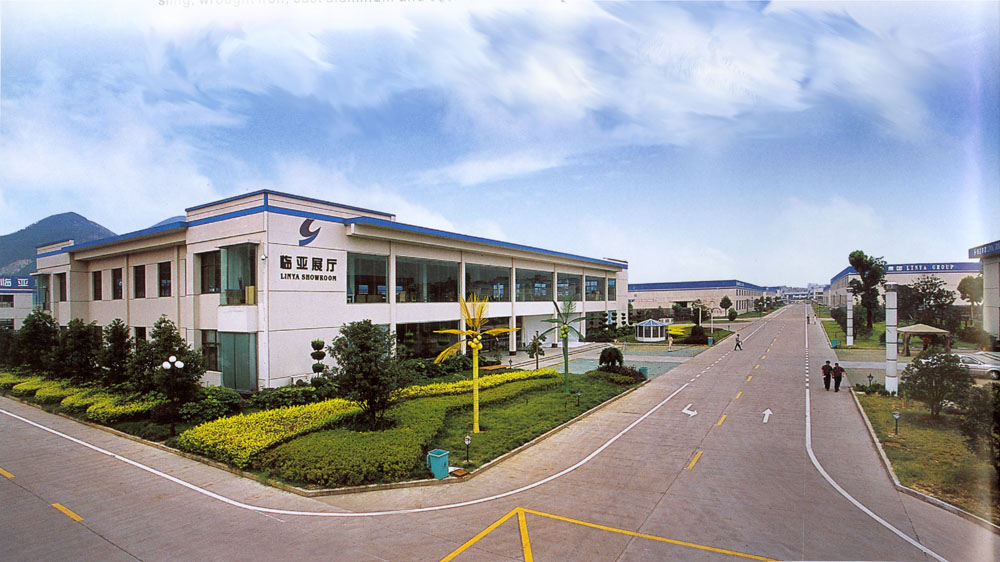
Linya Group Co., LTD Linya Group Ltd was established in November 1996. Prior to this our aluminium extrusion tubing company has traded since 1992. With the support of government policy, both national and local, Linya has worked hard to create a diversified group spanning investment, manufacturing, property and energy development sectors.
The group turns over million USD and exports million USD with capital assets of million USD. The manufacturing division covers an area of some 650 acres with a staff of over 5,000.
Linya is a leading business in Linhai city and is proud to promote local economic development. This has been recognised by the numerous awards we have achieved, including “Best private Enterprise” in Zhejiang province.
1、 Manufacturing
Linya aluminium extrusion tubing company is the most advanced manufacturing facility of aluminum alloy in eastern China. The factory covers an area of some 58,000 square meters with capital assets of 1million USD and has 16 aluminums profile extrusion lines.
The factory has equipment for anodic oxidation, electrophoresis paint and electrostatic spraying. Annual production capacity is 2 million tons. We have passed the ISO9001 quality system and have been recognized as the national nonferrous metal industry's most large-scale enterprise through the national metrology authentication unit. Our aluminum is used in construction, decoration and consumer products. The aluminum product is regarded as "the Chinese famous brand".
Zhejiang Linya craftwork Company Ltd covers an area of more than 200, 000 square meters, with a total investment of 2million USD. Our main products are outdoor leisure furniture, camping products, gazebos and sunshades. Every year, Linya exports more than 120 million dollars to Europe, America and Japan.
In July 2000 Linya obtained the import-export right. In October 2001 we obtained ISO9000 (2000) quality system authentication and related GS, CE certification.
Linya continually increases industrial infrastructure investment and enhances vertical integration to control quality and costs. In recent years the company invested ?million USD in industrial projects and invests heavily in technical renovation. This year the group invested ?USD in the updating of capital equipment to enable leaner and higher quality manufacturing and drive our competitive advantage.
2、Hydro-Electric Energy development
As part of Chinas’ national strategy to implement power transmission from west to east Linya have completed a hydropower scheme in Sichuan, Yunnan. This forms part of our group diversification strategy and the dam has a capacity of 0.5 Million Kilowatts. These projects give Linya Group long term revenue streams and strengthen our cashflow.
3、Propery and Investment business
Remote Desktop Services Sxs Network Stack ((better)) May 2026
However, the SxS stack is not without its complexities and challenges. The primary trade-off is . Maintaining multiple network stack instances requires additional non-paged pool memory and kernel processor time. On a server hosting 150 simultaneous sessions, the aggregate memory consumed by these isolated stacks can be substantial. Furthermore, the SxS stack introduces significant debugging complexity for network administrators. Traditional tools like netstat or performance monitors often show network connections aggregated by the physical stack, making it notoriously difficult to trace a connectivity issue back to a specific user session. This often forces IT teams to rely on proprietary RDS counters or PowerShell scripts to disaggregate the SxS data.
To understand the SxS stack, one must first understand the traditional problem of network stack sharing. In a standard Windows environment, the operating system maintains a single TCP/IP stack. All applications on that machine—whether a web browser, a file copy utility, or a database client—must share this single stack. For RDS, this poses a critical flaw. If a single user on a terminal server initiates a high-throughput operation, like a large file download, their session could monopolize the network stack’s buffers and processing threads. Consequently, other users would experience sudden disconnections, input lag, or frozen screens. The SxS Network Stack was engineered specifically to circumvent this "noisy neighbor" syndrome. remote desktop services sxs network stack
In conclusion, the Side-by-Side Network Stack is a quintessential example of Microsoft’s "systems engineering" approach to virtualization. It solves the acute problem of user isolation in multi-session environments with elegant kernel-level logic, turning a single server into a robust hosting platform for dozens of independent users. Yet, it introduces its own set of performance and troubleshooting challenges that demand skilled administration. As we move into an era of higher-bandwidth remote work—featuring 4K video streaming and real-time collaboration—the SxS stack will need to evolve further. Future iterations may need to incorporate dynamic resource allocation or even offload isolation to programmable network cards (SmartNICs). For now, understanding the SxS stack is not a technical luxury but a necessity for anyone tasked with delivering a seamless, stable remote desktop experience. It is the invisible scaffolding that holds up the virtual office. However, the SxS stack is not without its
The modern workplace is no longer a physical location but a connected ecosystem. At the heart of this transformation lies Remote Desktop Services (RDS), a technology that allows users to access applications and desktops hosted on central servers. While users focus on latency and image quality, a complex piece of engineering operates in the background to enable this magic: the Side-by-Side (SxS) Network Stack . This component, unique to the RDS architecture, represents a sophisticated solution to a fundamental problem—how to isolate, manage, and prioritize network traffic for dozens or hundreds of users sharing a single operating system instance. On a server hosting 150 simultaneous sessions, the
Another modern challenge is the interaction between the SxS stack and emerging network protocols, such as QUIC or encrypted DNS (DoH). These protocols assume a single, persistent network context. The SxS stack’s dynamic session mapping can inadvertently break connection migration features, leading to frequent reconnections. As organizations push for Zero Trust network architectures that rely on per-connection security tokens, the SxS stack’s abstraction layer adds another hop that security analysts must audit.
The SxS stack operates by creating logical, isolated instances of the network stack for each user session. From the perspective of the server’s kernel, User A’s TCP connections, timers, and sequence numbers exist in a separate context from User B’s. This isolation is achieved through modifications to the Transport Layer Interface (TLI) and the Windows Sockets (Winsock) catalog. When a user logs into an RDS session, the system dynamically maps their socket operations to a private, per-session network stack instance. This architecture ensures that a SYN flood or excessive retransmission from one session does not starve the resources of another, preserving the stability of the entire remote desktop environment.
In 1999, the group invested 8 million yuan in Jiuzhaigou Valley Sichuan province to build the four-star “Gesang Hotel”. The Building area is 30,000 square meters and has 310 rooms. Facilities include a Chinese and Western restaurant, recreation and performance hall, sauna, tea room and conference room.
In 2008, the group established Linya loan company Ltd. with registered capital of 20 million USD. The main function is to support the cash flow of local small and medium sized companies. This company continues to offer efficient service to local companies and works to enhance the areas economic prosperity.
|