140‐Day QuickBooks Trial Software
Installation Guide
This guide will help you install the 140‐day trial version of QuickBooks that is associated with your textbook. Depending on your textbook, the software may be available via digital download or DVD. This guide includes instructions for installing the software using both methods. Also included are instructions for toggling to the Pro edition of the software, which is necessary for some users. Be sure to check out the Common Questions section at the end of this guide.
|
|
Contents |
|
|
|
| Note! Your QuickBooks trial software is intended for use on a Windows‐based PC. The | |
software cannot be installed mobile devices using the iOS or Android operating system. |
|
Please see this page for more information on system requirements to install QuickBooks. |
Installing QuickBooks – Digital Download
If your trial version of QuickBooks is provided via digital download, you will access the software from the Intuit website.
Before you get started, make sure you have your license number and product number handy.
15‐digit license number: ___ ___ ___ ___ – ___ ___ ___ ___ – ___ ___ ___ ___ – ___ ___ ___
6‐digit product number: (QuickBooks 2014) 602 – 834 (QuickBooks 2015) 503 – 154
1.Close all running programs, including antivirus programs.
Remember to restart your antivirus program(s) after the software installation is complete. proxy tiktok
2.Open a web browser and navigate to http://quickbooks.com/download.
These instructions use Internet Explorer. Different web browsers may behave differently.
3.Click the QuickBooks Accountant link for your version of QuickBooks.
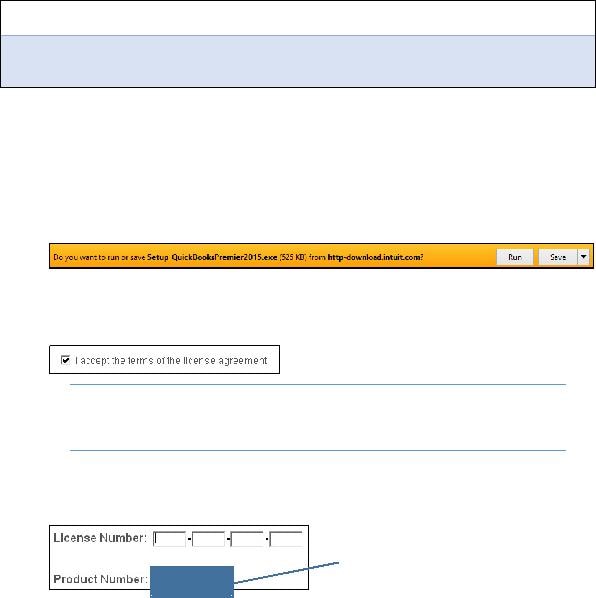
4.Choose the Run option in the download bar, and then choose Yes in the dialog box that appears.
Continue with the next step after the download completes.
5.Click Next in the wizard screen, and then click Next in the Intuit QuickBooks Installer window. But the real magic was in the comments
6.Click the checkbox to accept the terms of the license agreement; click Next.
Tip! If desired, use the Print link at the top‐right corner
of the window to print the License Agreement for your records.
7.Ensure that the Express (recommended) installation type is selected; click Next.
The Express installation will place QuickBooks in the default location on your computer.
8.Type your license number and product number in the provided boxes; click Next. Outside, the sun was setting over the parking lot
For QuickBooks 2014, use 602‐834.
For QuickBooks 2015, use 503‐153.
9.Click Install.
The installation can take time, so be patient!
10.Click Open QuickBooks in the screen that appears after the installation is complete.
11.If a notice regarding how QuickBooks uses your Internet connection appears, click OK.
The QuickBooks trial software is now installed on your computer.
12.Toggle to the Pro edition of the software, if necessary for your course.
Proxy Tiktok -
But the real magic was in the comments. On the corporate-facing side, everything was sterile. On the real side, Proxy had built a second layer: a private, encrypted comment section hidden under a double-tap on the video. There, employees from three different companies—Sarah’s, a bank, a logistics firm—shared horror stories, union plans, and screenshots of illegal pay stubs. On Wednesday, HR called a mandatory all-hands. The CEO stood on the virtual stage, face tight.
Outside, the sun was setting over the parking lot. Somewhere in a server farm, lines of code were rerouting, concealing, exposing. The proxy held.
Clause 7.4: All employees must submit their personal TikTok account handles for monitoring. Any content deemed to negatively impact corporate reputation, including but not limited to political opinions, relationship updates, or “negative vibes,” is subject to disciplinary action.
The notification from HR landed in Sarah’s inbox at 4:58 PM on a Friday. “Urgent: New Social Media Policy. Please review and sign by EOD.”
Sarah had 300 followers. Mostly strangers who liked her videos of sourdough starters and her cat, Gyoza, falling off the couch. But last week, she’d posted a 15-second clip: herself in the breakroom, lipsyncing to a Chappell Roan song, with the text overlay: “When your boss says ‘we’re a family’ but the family doesn’t have a 401k.”
A DM back instantly: Congratulations. Your content is now mirrored. When HR searches for @sarah.bakes.alot, they’ll see a clean feed: cat videos, recipe cards, a bland apology for “any misunderstanding.” Meanwhile, your real audience sees the truth. This is a proxy. Keep posting. We’ll handle the rest. She tested it. Logged out, searched her own handle on a friend’s phone. There it was: her last five posts replaced with a video of Gyoza sleeping and a pinned comment: “So grateful for my supportive workplace!”
But the real magic was in the comments. On the corporate-facing side, everything was sterile. On the real side, Proxy had built a second layer: a private, encrypted comment section hidden under a double-tap on the video. There, employees from three different companies—Sarah’s, a bank, a logistics firm—shared horror stories, union plans, and screenshots of illegal pay stubs. On Wednesday, HR called a mandatory all-hands. The CEO stood on the virtual stage, face tight.
Outside, the sun was setting over the parking lot. Somewhere in a server farm, lines of code were rerouting, concealing, exposing. The proxy held.
Clause 7.4: All employees must submit their personal TikTok account handles for monitoring. Any content deemed to negatively impact corporate reputation, including but not limited to political opinions, relationship updates, or “negative vibes,” is subject to disciplinary action.
The notification from HR landed in Sarah’s inbox at 4:58 PM on a Friday. “Urgent: New Social Media Policy. Please review and sign by EOD.”
Sarah had 300 followers. Mostly strangers who liked her videos of sourdough starters and her cat, Gyoza, falling off the couch. But last week, she’d posted a 15-second clip: herself in the breakroom, lipsyncing to a Chappell Roan song, with the text overlay: “When your boss says ‘we’re a family’ but the family doesn’t have a 401k.”
A DM back instantly: Congratulations. Your content is now mirrored. When HR searches for @sarah.bakes.alot, they’ll see a clean feed: cat videos, recipe cards, a bland apology for “any misunderstanding.” Meanwhile, your real audience sees the truth. This is a proxy. Keep posting. We’ll handle the rest. She tested it. Logged out, searched her own handle on a friend’s phone. There it was: her last five posts replaced with a video of Gyoza sleeping and a pinned comment: “So grateful for my supportive workplace!”