
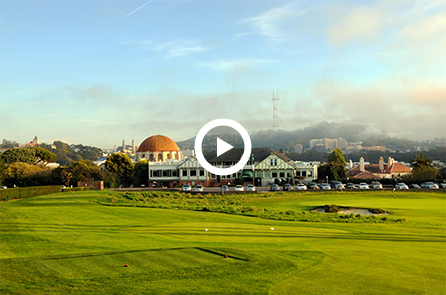
About Presidio Golf Course

Located within a national park, San Francisco’s Presidio Golf Course is renowned for its spectacular forest setting, as well as its challenging play. Once restricted to military officers and private club members, today the 18-hole course is open to the public. Presidio G.C. offers a full service restaurant, a driving range and practice facility, and an award winning golf shop that offers the latest in golf equipment and apparel. Presidio Golf Course is a contributing feature of the Presidio’s National Historic Landmark status. It is also notable for its environmentally sensitive management practices.

The Course

God shaped this land to be a golf course. I simply followed nature.
– John Lawson, designer of the first course

Presidio Golf Course is built on a variety of terrains. Holes are constructed over a base of adobe clay, rock, sand, or a combination of all three. The early Presidio Golf Course was short, but challenging. Players were often shocked by the level of difficulty and natural obstacles. Lawson Little, stamped by Golf Magazine as the greatest match player in the game’s history, said, “I have played the best courses here and abroad, but none more enjoyable than my home course of Presidio. I learned how to strike the ball from every conceivable lie. Presidio demands accuracy, but being a long hitter, I also had to learn how to hook or fade around trees. I had the reputation of being a strong heavy-weather golfer; well, Presidio has powerful wind, rain, fog, sudden gusts, and sometimes all four on any given round.”

Environmental Sensitivity

Presidio Golf Course has been recognized as a leader in environmentally sensitive golf course management, winning the 2001 “Environmental Leader in Golf Award”. Since 2000, the course has reduced overall pesticide use by approximately 50%, and currently uses approximately 75% less pesticide than private courses in San Francisco. The course also received certification from Audubon International as a partner in the Audubon Cooperative Sanctuary Program in 2003.

The course uses an innovative form of pest management and turf management called compost tea. “Compost tea” is a solution made by soaking compost in water to extract and increase the beneficial organisms present in the compost. It is then sprayed over the greens. The result is turf with longer root growth and less plant disease fungi.

Ftp ((better)) — Alif Laila

If this is not what you intended, please clarify your request. Introduction For over a millennium, Alif Laila , or One Thousand and One Nights , has captivated readers across the globe. From the framing story of Scheherazade, who delays her execution by telling captivating tales night after night, to the embedded adventures of Sinbad, Aladdin, and Ali Baba, this sprawling collection of Middle Eastern and South Asian folklore has shaped world literature. However, in the twenty-first century, the preservation and dissemination of such a vast textual and cultural heritage face new challenges and opportunities. The humble File Transfer Protocol (FTP) — a technology often overlooked in the age of cloud computing — has played a quiet but crucial role in the digital transmission of Alif Laila . This essay explores the journey of Alif Laila from oral storytelling to digital repositories, arguing that while FTP is a utilitarian tool, its application in archiving and sharing the Nights highlights the tension between open access to cultural heritage and the need for scholarly integrity. From Orality to Codex: The Pre-Digital Life of Alif Laila Before the digital revolution, Alif Laila survived through a complex web of oral recitations, medieval Arabic manuscripts (such as the 14th-century Syrian manuscript), and European translations — most famously by Antoine Galland (1704–1717) and Richard Francis Burton (1885–1888). These versions varied wildly in content, language, and morality. The lack of a single authoritative text meant that any attempt to preserve Alif Laila required collecting multiple recensions. Libraries and universities housed fragile manuscripts, but access was limited to scholars with the means to travel. This scarcity created a closed ecosystem of knowledge, far from Scheherazade’s democratic ideal of storytelling for all. The Digital Turn: Why FTP Matters The advent of the internet brought new hope for democratizing access to Alif Laila . However, in the 1990s and early 2000s, before widespread cloud storage and streaming, FTP was the primary method for transferring large files over networks. Universities, public domain archives, and early digital humanities projects relied on FTP servers to share scanned manuscripts, plain-text translations, and scholarly annotations.

Why FTP specifically for Alif Laila ? First, the complete Burton translation in plain text exceeds 1.5 megabytes — trivial today, but significant on dial-up connections. FTP allowed resumable downloads and batch transfers, making it reliable. Second, FTP servers were easy to set up on university mainframes, enabling institutions like the University of Adelaide (which hosted a famous Nights text collection) or Project Gutenberg to distribute the work freely. Third, FTP’s folder hierarchy allowed logical organization: for example, /alif_laila/arabic_manuscripts/ , /alif_laila/burton/ , /alif_laila/critical_essays/ . Project Gutenberg — the oldest digital library — has distributed multiple versions of One Thousand and One Nights via FTP since 1971. A user connecting to ftp.ibiblio.org could navigate to /pub/docs/books/gutenberg/ and download files like 1001.txt (Burton’s unexpurgated translation). This FTP-based distribution was revolutionary: a student in Karachi, a researcher in Cairo, or a storyteller in Marrakesh could, with an internet connection and an FTP client, access the same text as a Harvard professor. FTP thus fulfilled a core promise of Alif Laila itself — that stories belong to everyone, not just the powerful. Challenges: Incomplete Texts, Encoding Issues, and Copyright Despite its utility, FTP distribution of Alif Laila has significant drawbacks. Early FTP archives often contained corrupted or truncated files due to transfer errors. Moreover, character encoding was a nightmare: Arabic script required Unicode, but many FTP servers in the 1990s used ASCII or Latin-1, rendering the original language illegible. Consequently, most FTP distributions offered only English translations, privileging Western readers over Arabic speakers. Furthermore, some translations remain under copyright (e.g., Husain Haddawy’s 1990 edition), making them unavailable on open FTP servers. The protocol itself, lacking encryption, also meant that sensitive scholarly materials could be intercepted. FTP Today and the Future of Alif Laila In 2025, FTP is largely obsolete, replaced by HTTPS, SFTP, and cloud storage. However, its legacy endures. Many historical FTP archives have been migrated to modern platforms, but the ethos of open, folder-based access persists. Today, initiatives like the Arabian Nights Digital Archive at the University of Oxford use more sophisticated systems, yet they owe a debt to the early FTP pioneers who insisted that Alif Laila should not be locked behind paywalls. alif laila ftp

Moreover, the metaphor of FTP — transferring pieces of a whole from server to client — mirrors the structure of Alif Laila itself. Scheherazade transfers fragments of narrative night by night, assembling a vast, interconnected whole. Each user who downloads a file from an FTP server becomes, in a small way, a Scheherazade, keeping the stories alive through transmission. The request to write an essay on “Alif Laila ftp” might at first seem absurd — a medieval story collection meets a utilitarian internet protocol. Yet upon examination, the conjunction reveals a profound truth: cultural heritage in the digital age depends on infrastructure that is often invisible. FTP, for all its technical limitations, enabled the first large-scale, open dissemination of Alif Laila across the globe. It broke down geographical and economic barriers, albeit imperfectly, and foreshadowed today’s debates over digital rights, preservation, and access. As we move into an era of AI-generated summaries and streaming audiobooks, we should remember the humble FTP server — a silent carrier of Scheherazade’s voice across the network. In the end, every protocol is a story about how we want to share what we value. If you intended something entirely different (e.g., a film titled Alif Laila , a specific FTP server containing its files, or a typo for another term like "Alif Laila and the Forty Thieves" [Alibaba]), please provide clarification so I can write the correct essay. If this is not what you intended, please

Presidio Golf Course, A National Historic Landmark

A National Historic Landmark Since 1962

Originally designed by Robert Wood Johnstone, the golf course was expanded in 1910 by Johnstone in collaboration with Wiliam McEwan, and redesigned and lengthened in 1921 by the British firm of Fowler & Simpson.

LEARN MORE

If this is not what you intended, please clarify your request. Introduction For over a millennium, Alif Laila , or One Thousand and One Nights , has captivated readers across the globe. From the framing story of Scheherazade, who delays her execution by telling captivating tales night after night, to the embedded adventures of Sinbad, Aladdin, and Ali Baba, this sprawling collection of Middle Eastern and South Asian folklore has shaped world literature. However, in the twenty-first century, the preservation and dissemination of such a vast textual and cultural heritage face new challenges and opportunities. The humble File Transfer Protocol (FTP) — a technology often overlooked in the age of cloud computing — has played a quiet but crucial role in the digital transmission of Alif Laila . This essay explores the journey of Alif Laila from oral storytelling to digital repositories, arguing that while FTP is a utilitarian tool, its application in archiving and sharing the Nights highlights the tension between open access to cultural heritage and the need for scholarly integrity. From Orality to Codex: The Pre-Digital Life of Alif Laila Before the digital revolution, Alif Laila survived through a complex web of oral recitations, medieval Arabic manuscripts (such as the 14th-century Syrian manuscript), and European translations — most famously by Antoine Galland (1704–1717) and Richard Francis Burton (1885–1888). These versions varied wildly in content, language, and morality. The lack of a single authoritative text meant that any attempt to preserve Alif Laila required collecting multiple recensions. Libraries and universities housed fragile manuscripts, but access was limited to scholars with the means to travel. This scarcity created a closed ecosystem of knowledge, far from Scheherazade’s democratic ideal of storytelling for all. The Digital Turn: Why FTP Matters The advent of the internet brought new hope for democratizing access to Alif Laila . However, in the 1990s and early 2000s, before widespread cloud storage and streaming, FTP was the primary method for transferring large files over networks. Universities, public domain archives, and early digital humanities projects relied on FTP servers to share scanned manuscripts, plain-text translations, and scholarly annotations.

Why FTP specifically for Alif Laila ? First, the complete Burton translation in plain text exceeds 1.5 megabytes — trivial today, but significant on dial-up connections. FTP allowed resumable downloads and batch transfers, making it reliable. Second, FTP servers were easy to set up on university mainframes, enabling institutions like the University of Adelaide (which hosted a famous Nights text collection) or Project Gutenberg to distribute the work freely. Third, FTP’s folder hierarchy allowed logical organization: for example, /alif_laila/arabic_manuscripts/ , /alif_laila/burton/ , /alif_laila/critical_essays/ . Project Gutenberg — the oldest digital library — has distributed multiple versions of One Thousand and One Nights via FTP since 1971. A user connecting to ftp.ibiblio.org could navigate to /pub/docs/books/gutenberg/ and download files like 1001.txt (Burton’s unexpurgated translation). This FTP-based distribution was revolutionary: a student in Karachi, a researcher in Cairo, or a storyteller in Marrakesh could, with an internet connection and an FTP client, access the same text as a Harvard professor. FTP thus fulfilled a core promise of Alif Laila itself — that stories belong to everyone, not just the powerful. Challenges: Incomplete Texts, Encoding Issues, and Copyright Despite its utility, FTP distribution of Alif Laila has significant drawbacks. Early FTP archives often contained corrupted or truncated files due to transfer errors. Moreover, character encoding was a nightmare: Arabic script required Unicode, but many FTP servers in the 1990s used ASCII or Latin-1, rendering the original language illegible. Consequently, most FTP distributions offered only English translations, privileging Western readers over Arabic speakers. Furthermore, some translations remain under copyright (e.g., Husain Haddawy’s 1990 edition), making them unavailable on open FTP servers. The protocol itself, lacking encryption, also meant that sensitive scholarly materials could be intercepted. FTP Today and the Future of Alif Laila In 2025, FTP is largely obsolete, replaced by HTTPS, SFTP, and cloud storage. However, its legacy endures. Many historical FTP archives have been migrated to modern platforms, but the ethos of open, folder-based access persists. Today, initiatives like the Arabian Nights Digital Archive at the University of Oxford use more sophisticated systems, yet they owe a debt to the early FTP pioneers who insisted that Alif Laila should not be locked behind paywalls.

Moreover, the metaphor of FTP — transferring pieces of a whole from server to client — mirrors the structure of Alif Laila itself. Scheherazade transfers fragments of narrative night by night, assembling a vast, interconnected whole. Each user who downloads a file from an FTP server becomes, in a small way, a Scheherazade, keeping the stories alive through transmission. The request to write an essay on “Alif Laila ftp” might at first seem absurd — a medieval story collection meets a utilitarian internet protocol. Yet upon examination, the conjunction reveals a profound truth: cultural heritage in the digital age depends on infrastructure that is often invisible. FTP, for all its technical limitations, enabled the first large-scale, open dissemination of Alif Laila across the globe. It broke down geographical and economic barriers, albeit imperfectly, and foreshadowed today’s debates over digital rights, preservation, and access. As we move into an era of AI-generated summaries and streaming audiobooks, we should remember the humble FTP server — a silent carrier of Scheherazade’s voice across the network. In the end, every protocol is a story about how we want to share what we value. If you intended something entirely different (e.g., a film titled Alif Laila , a specific FTP server containing its files, or a typo for another term like "Alif Laila and the Forty Thieves" [Alibaba]), please provide clarification so I can write the correct essay.

alif laila ftp
Processing...
Thank you! Your subscription has been confirmed. You'll hear from us soon.
EMAIL SPECIALS
Join our email specials list to get our Weekly Update newsletter and occasional other specials and event announcements!
ErrorHere